What our 2025 Projects Are Teaching Us About Net Zero
As grids decarbonize, renewable energy strategies evolve, and carbon accounting becomes more sophisticated, long-held assumptions about Net Zero are shifting. In this four-part series, EHDD Sustainable Design Strategist Alex Ianchenko explores lessons emerging from EHDD’s recent project work — from carbon tradeoffs and renewable energy procurement to grid dynamics and the future of high-performance design.
In 2026, the question is no longer whether to decarbonize, but how to do it well. Fully electrified, renewable-powered buildings are becoming both technically achievable and increasingly expected. The challenge now is less about feasibility, and more about how we measure, evaluate, and deliver a fully-electrified building stock. Since 2020, EHDD’s approach to building performance has centered carbon reduction as a core design driver, but we are continuously learning how to materialize our aspiration to climate-positive design in each of our projects. Our recent AIA 2030 Commitment reporting gave us an opportunity to step back and look at what’s changing across our work.
In 2025, EHDD reported 27 projects totaling nearly 1.5 million square feet through the AIA 2030 Commitment. Across the portfolio, projects achieved an average predicted EUI reduction of 68%, and were designed to operate fully electrically — from labs and visitor centers to schools and student housing. Half of them included on-site solar arrays; eight projects were further committed to purchasing renewable energy through institutional green tariff programs, or power purchase agreements. Together, these strategies are helping drive major reductions in operational carbon intensity across the portfolio — the real focus of the AIA 2030 Commitment. More importantly, they are reshaping how we think about Net Zero performance in a rapidly decarbonizing energy landscape.
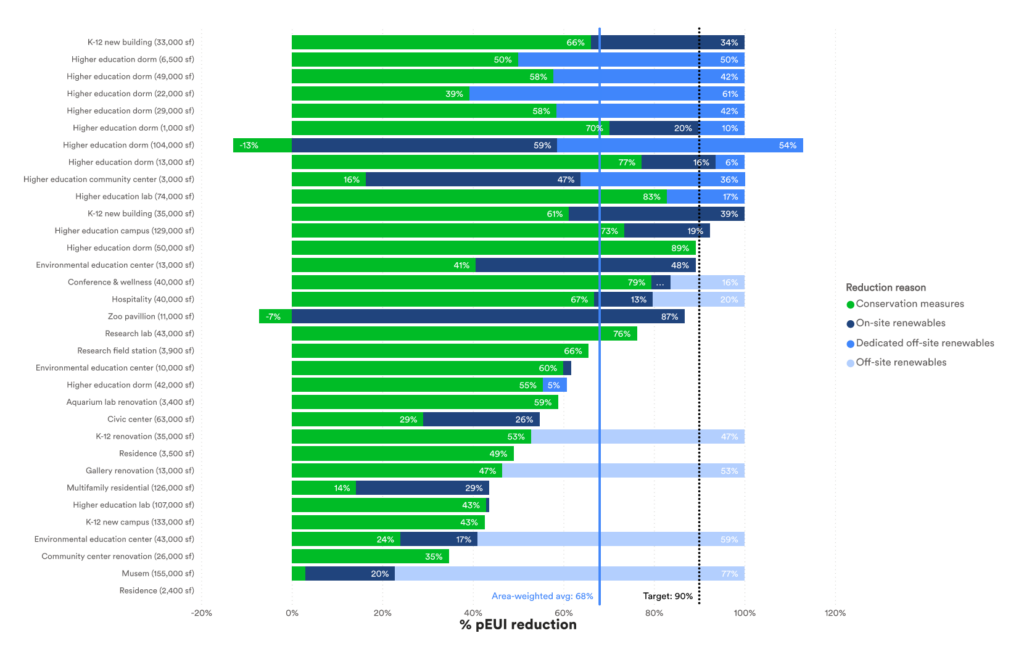
Our reporting fits into a larger pattern, even though 1.5 million square feet is less than 0.5% of the total area reported through the Design Data Exchange. Even as policy, infrastructure, and energy demand challenges continue to evolve in the U.S., the broader transition toward renewable energy continues to accelerate globally – in most regions, solar and wind are now cheaper to develop than fossil-fuel alternatives. Utility companies across the U.S. are also working to decarbonize the grid — a challenge made more complex by rising electricity demand after nearly 15 years of relative plateauing.
In the next post, we’ll look at how operational and embodied carbon are increasingly being treated as part of the same conversation.
This piece was developed by Alex Ianchenko, LEED AP BD+C, Sustainable Design Strategist at EHDD. Alex leads EHDD’s effort to create measurable positive impact through projects – ranging from building decarbonization to improving public health outcomes and conserving ecosystems.
About EHDD
EHDD is an award-winning architecture firm with a strong commitment to advancing climate action through sustainable design. With decades of experience helping clients achieve their dreams, EHDD creates transformative places of belonging and impact. Learn more at ehdd.com
Media Contact
Ana Wansink
Director of Marketing & Business Development
EHDD
a.wansink@ehdd.com
+1 (415) 214 7271