Not All Solar Arrays Are Created Equal
This is the third post in the “What Our 2025 Projects Are Teaching Us About Net Zero” series, sharing what EHDD has learned from our 2030 Commitment reporting this year.
One surprising finding from a recent EHDD study: bigger solar arrays don’t always produce bigger carbon savings.
We evaluated three alternative rooftop solar configurations for a new multifamily building in New York City, slated to open in 2028:
• Ballast
• Post & rail, and
• Trellis
One finding stood out: despite accommodating larger solar arrays, the post & rail and trellis configurations were not projected to “pay off” their upfront carbon emissions before the grid is expected to decarbonize. Using projected annual grid emission factors from NYSERDA, we found that the ballast configuration came closest to balancing its upfront embodied carbon cost with the operational carbon benefit of displacing grid electricity. As the local grid continues to decarbonize, those benefits diminish because the electricity being displaced is already becoming much cleaner (see Figure 1).
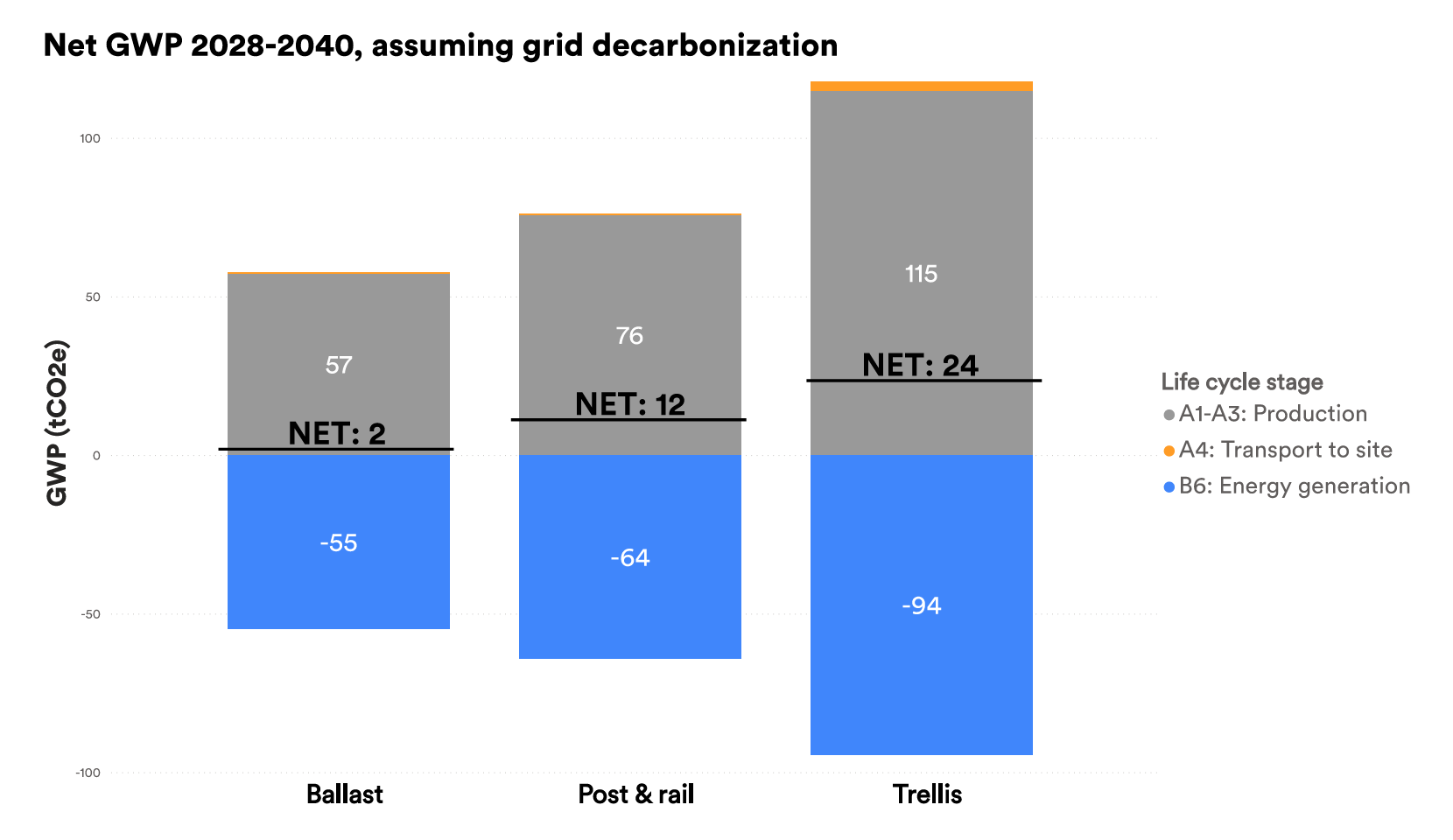
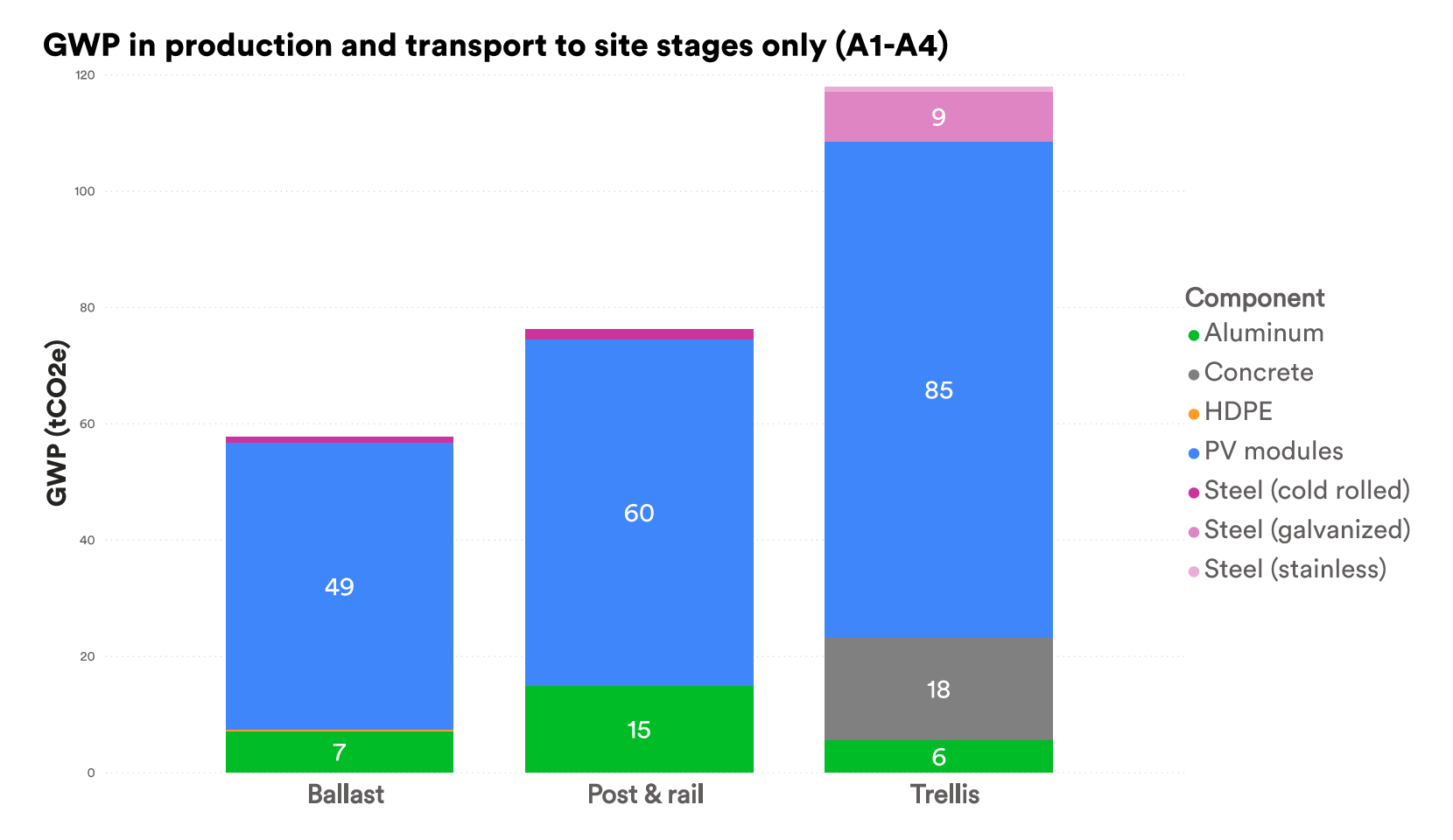
So why does this happen? The driver was upfront embodied carbon. The post & rail and trellis configurations requires more emissions to manufacture more solar panels and enabling structural materials (see Figure 2). Notably, the trellis configuration required increasing the thickness of the concrete roof deck to support the concentrated loads created by the array, further increasing the upfront carbon impact of the building’s structure. In all, the trellis option was projected to have roughly double the upfront impact of the ballast configuration.
As with any model, these findings are sensitive to the assumptions used. In this case, the study relies on a generic OneClick LCA datapoint to estimate the impact of manufacturing monocrystalline solar panels. As more manufacturer-specific data becomes available, the projected “breakeven” point would likely shift, although the relative comparison between the three scenarios would likely remain the same.
So what does this mean in practice? Two things stand out. First, the era of operational carbon credits offsetting “what could have been” is beginning to close, particularly in jurisdictions where the grid is rapidly decarbonizing. Projects on our boards today will increasingly be powered by cleaner electricity. Second, not all solar arrays are created equal. Some options require significantly more materials, resulting in much higher upfront embodied carbon emissions.
The implication is clear: more solar isn’t always a better carbon outcome. In some situations, solar arrays that require significant new structural materials may not deliver the carbon benefits we expect – particularly where the electrical grid is rapidly decarbonizing in resource-efficient ways at the utility scale.
So, does this change how we think about on-site solar arrays? The short answer is no, but it does add important context.
First, this finding assumes the NYSERDA grid will decarbonize on schedule – an ambitious goal, given that approximately half of the electricity generated in neighboring eGRID subregions currently comes from methane gas, and electricity demand is on the rise. After all, the grid is interconnected, and adding new renewable energy today is still a good thing.
Second, these findings only apply in jurisdictions that are legally committed to decarbonizing their electrical grids. As of 2026, only 24 states have legislated 100% clean energy goals, so these findings do not apply in the same way elsewhere.
Finally, these results are highly sensitive to how we measure the embodied carbon of manufacturing solar panels. Until third-party verified, manufacturer-specific data becomes available, our model is a napkin sketch at best. More importantly, greater supply chain transparency is essential to help safeguard solar workers from forced labor and human rights violations.
In the meantime, our investigation prompted us to recommend the ballast array configuration for this project, despite a reduced array capacity – the savings in materials and the decarbonization of the whole grid in this location made the tradeoff worth it.
In the final article, we’ll explore another factor that’s reshaping how we think about carbon accounting: off-site renewable energy.
This piece was developed by Alex Ianchenko, LEED AP BD+C, Sustainable Design Strategist at EHDD. Alex leads EHDD’s effort to create measurable positive impact through projects – ranging from building decarbonization to improving public health outcomes and conserving ecosystems. Credit to Laura Fermoso with STAT Architecture for defining the comparison study parameters & leading the design of the project.
About EHDD
EHDD is an award-winning architecture firm with a strong commitment to advancing climate action through sustainable design. With decades of experience helping clients achieve their dreams, EHDD creates transformative places of belonging and impact. Learn more at ehdd.com
Media Contact
Ana Wansink
Director of Marketing & Business Development
EHDD
a.wansink@ehdd.com
+1 (415) 214 7271