Carbon is the new currency
This is the second post in the “What Our 2025 Projects Are Teaching Us About Net Zero” series, sharing what EHDD has learned from our 2030 Commitment reporting this year.
As electricity gets cleaner, embodied carbon is becoming an increasingly important part of the Net Zero conversation.
For decades, the building industry has focused on reducing operational energy use and transitioning buildings away from fossil fuels. But as electrical grids decarbonize, another question is becoming increasingly important: what is the carbon cost of the materials and systems we use to get there?
Operational carbon remains a foundational metric for understanding building performance. Within the AIA 2030 Commitment framework, it helps us measure the greenhouse gas emissions associated with the energy our buildings consume. Net Zero Energy buildings like EHDD’s pioneering IDeAs office building both reduce energy demand and generate enough renewable electricity on-site to meet their operational needs.
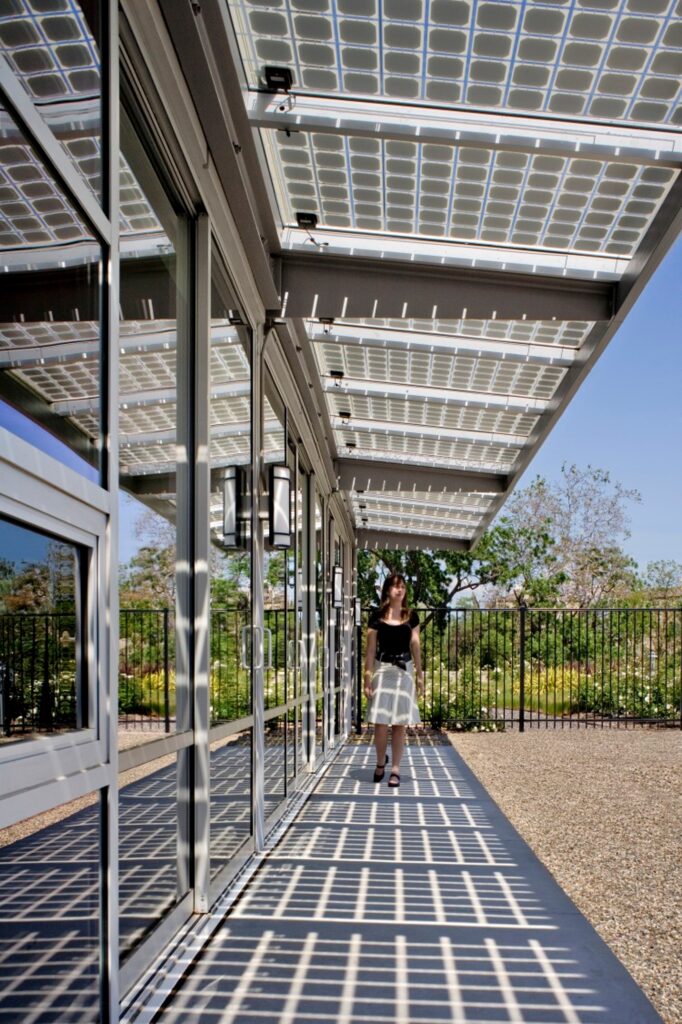
Operational carbon is the metric architects use today to understand the impact of replacing fossil fuels with renewable electricity within the AIA 2030 Commitment. Projects that report on-site renewable energy generation claim a negative “credit” that reduces their net operational carbon. The math is simplified: every watt generated by a solar panel is one less watt that needs to be supplied by the grid, where it was possibly generated by burning fossil fuels. The dirtier the grid, the greater the operational carbon benefit of generating and consuming renewable electricity instead.
But operational carbon is only part of the story.
We also need to consider the “other carbon in the room” — embodied carbon. Embodied carbon describes the greenhouse gas emissions released during the extraction, manufacturing, and transportation of building materials. Importantly, embodied carbon does not refer to carbon “embedded” in materials – rather, it describes emitted greenhouse gases that are now trapping heat in the atmosphere. Building materials matter more than many people realize. Roughly one-third of U.S. greenhouse gas emissions come from industry, and at least 5% are directly tied to manufacturing building materials domestically. For context, commercial aviation accounts for approximately 2% of annual U.S. emissions.5
The relationship between embodied and operational carbon is especially interesting when working with solar panels. Solar panels do not arrive on project sites carbon-free. Steel trellises, aluminum rails and racks, and crystalline silicon cells all carry their own embodied carbon price tag – and many of these components are manufactured overseas (as of 2022, China’s share of global photovoltaic manufacturing exceeded 80%). There is no pathway to a stable climate without transitioning the electric grid away from fossil fuels. These upfront emissions are a necessary part of that transition. But what does this mean in the context of the buildings we design? In the previous post, we saw that roughly half of EHDD’s 2025 projects included some form of on-site solar. In the next article, we’ll explore what happens when operational and embodied carbon collide through a case study of three rooftop solar strategies for a multifamily project in New York.
This piece was developed by Alex Ianchenko, LEED AP BD+C, Sustainable Design Strategist at EHDD. Alex leads EHDD’s effort to create measurable positive impact through projects – ranging from building decarbonization to improving public health outcomes and conserving ecosystems.
About EHDD
EHDD is an award-winning architecture firm with a strong commitment to advancing climate action through sustainable design. With decades of experience helping clients achieve their dreams, EHDD creates transformative places of belonging and impact. Learn more at ehdd.com
Media Contact
Ana Wansink
Director of Marketing & Business Development
EHDD
a.wansink@ehdd.com
+1 (415) 214 7271