Beyond the Building
This is the fourth and final post in the “What Our 2025 Projects Are Teaching Us About Net Zero” series, sharing what EHDD has learned from our 2030 Commitment reporting this year.
The future of Net Zero extends beyond the building itself. As campuses, utilities, and regulations evolve, building performance is increasingly being shaped by the broader grid they’re connected to.
EHDD has had the privilege of working with many public higher education institutions across the West Coast—from UC San Diego to the University of Washington. Many of these clients are leaders in climate action, using their collective purchasing power to invest in renewable energy generation through participating in utility green tariff programs and purchasing renewable energy credits (RECs). Of the 27 projects on our boards in 2025, nearly one-third included plans to purchase renewable electricity generated off-site.
We see this as a growing trend in institutional work. When developing a new building on a campus, owners choose to ‘scale up’ their effort and develop a centralized off-site solar array rather than opting to tackle Net Zero Energy within the property line. While this pathway is rarely available to building owners who operate on a smaller scale, it’s an important trend to recognize. Building owners and developers who manage extensive portfolios may be outgrowing the site boundaries of the original Net Zero Energy concept.
At the same time, awareness has grown about the “duck curve” – the graph that describes how net electricity demand behaves when utility-scale solar enters the power grid. Most of EHDD’s projects are located within the California Independent System Operator (CAISO) balancing authority, an exemplary case study region in the U.S. for transitioning to solar energy. During the day, solar now supplies enough electricity to meet most of CAISO’s demand. But as solar generation drops in the evening, fossil fuel “peaker” plants still ramp up to meet demand – creating the steep climb that gives the “duck curve” its name.
For the building industry, this translates to a new responsibility to manage electricity supply and demand through strategies like battery storage and load management. Increasingly, our focus is shifting from how much electricity our projects use to when they use it. EHDD designed the GridOptimal Sonoma Clean Power Headquarters with load management as a core design driver. This project combines passive strategies, active systems, and battery storage to “charge” the building when renewable electricity is abundant and operate “off-grid” during periods when peaker plants are brought online.
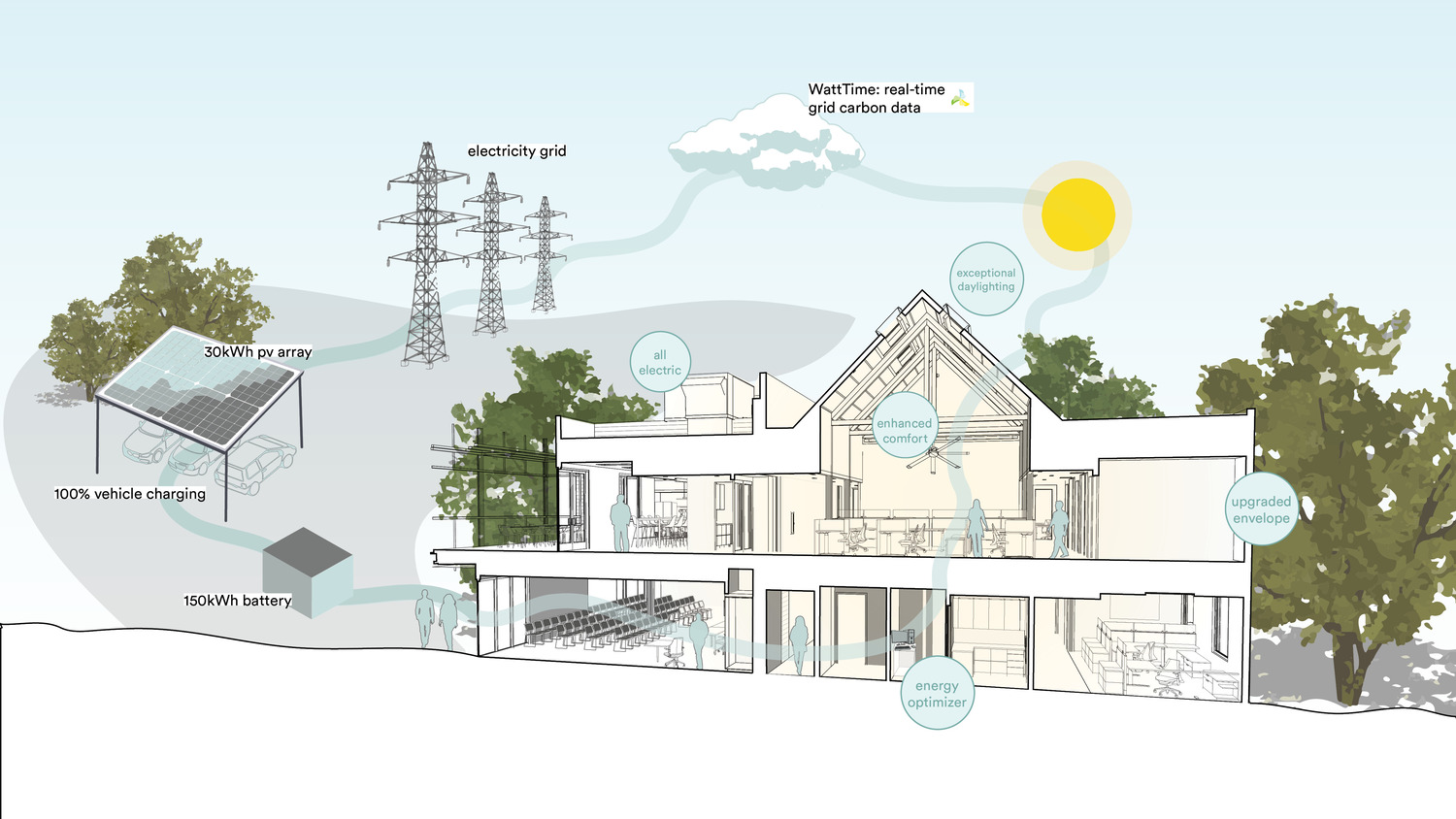
This shift isn’t just changing design practice – it’s beginning to influence regulation as well. Our codes are evolving in the same direction, placing greater emphasis on grid-sensitive metrics. California’s latest energy code Title 24, Part 6, which came into effect on January 1, 2026, introduces a new metric – Long-Term System Cost (LSC) – to replace the established Time Dependent Value (TDV). LSC measures the long-term impact each new building has on California’s energy system, reflecting broader infrastructure planning priorities. Recent research from CBE at Berkeley supports this shift – investigating 600 commercial buildings across US grid regions, researchers found that annual and seasonal grid emission averages (like the familiar metric EUI) “substantially oversimplify grid dynamics”, which can lead to inaccurate carbon accounting. We expect the AIA 2030 Challenge and COTE will increasingly shift focus toward time-sensitive operational carbon metrics to better support AIA’s Climate Action Plan.
The future of Net Zero isn’t just about better buildings—it’s about better energy systems.
The Net Zero Energy concept is growing into its teens – and with this, gaining a new level of sophistication and nuance. As we learn more about embodied carbon, utility-scale renewable energy procurement, and load management, we are also seeing the solar arrays that we design in a broader context – one shaped by energy systems that extend well beyond the project boundary. Renewable energy is unquestionably part of the future – but that future may look different than we imagined a decade ago: more batteries and large-scale off-site arrays, and fewer building-integrated solar panels. However, to adapt an oft-quoted phrase from Carl Elefante, the greenest watt is the one that doesn’t need to be generated in the first place, solar or otherwise. Reducing total energy demand so that we are free to take fossil fuel plants offline, permanently, remains a foundational part of building a livable future for all.
This piece was developed by Alex Ianchenko, LEED AP BD+C, Sustainable Design Strategist at EHDD. Alex leads EHDD’s effort to create measurable positive impact through projects – ranging from building decarbonization to improving public health outcomes and conserving ecosystems.
About EHDD
EHDD is an award-winning architecture firm with a strong commitment to advancing climate action through sustainable design. With decades of experience helping clients achieve their dreams, EHDD creates transformative places of belonging and impact. Learn more at ehdd.com
Media Contact
Ana Wansink
Director of Marketing & Business Development
EHDD
a.wansink@ehdd.com
+1 (415) 214 7271